
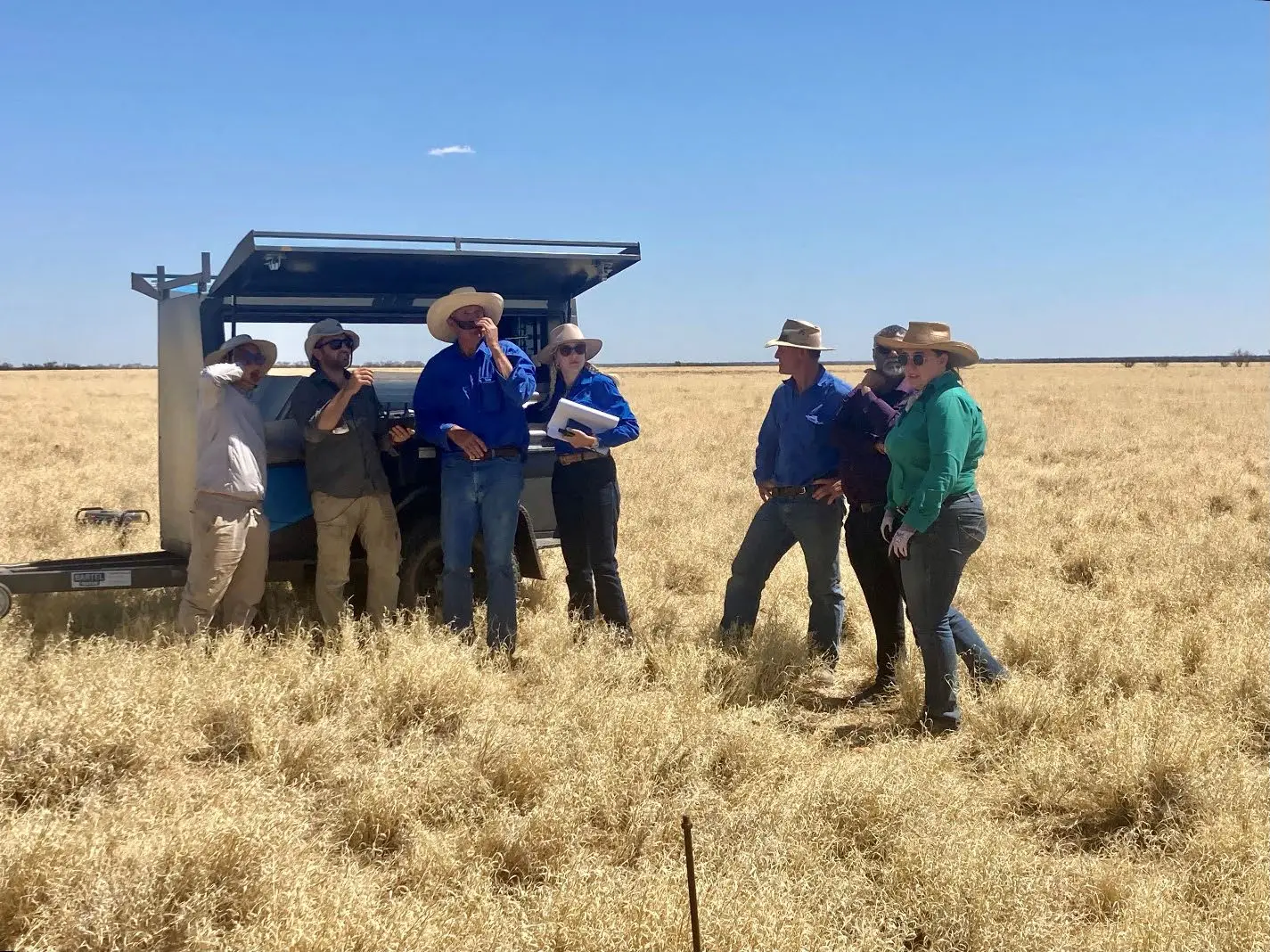
Farmers and advisors standing in golden perennial grass beside a ute at a field day

RAIZ · Case Study · Australia

Demonstration of bare ground restoration in the Southern Gulf Region

Bringing drought-affected soils back to productivity, drought resilience and sustainability

Location
North West Queensland, Australia
Stage of implementation
Demonstration / pilot, delivered 2020–2024
Lead entity
Australian Government Department of Agriculture, Fisheries and Forestry

Key figures

Australian Government - Department of Agriculture, Fisheries and Forestry
Future Drought FundReached in December 2024, up from A$3.9B in 2019
A$5B
Drought Resilient Soils and Landscapes program26 projects, 2020–2024
A$23.1M+
Grant to Southern Gulf NRMCore delivery funding, 2020–2024
A$667,500
Demonstration sitesAcross 2 districts in North West Queensland
13
Hectares under demonstrationUp to 4,000 hectares across the sites
4,000
Hectares of bare groundEstimated in North West Queensland - the scope for wider adoption
1.5M

Mapping the problem

Australia is the driest inhabited continent, with drought a recurring feature of the landscape. Climate models indicate that future rainfall patterns are likely to change, with more severe droughts and extreme weather events. These impacts are already being felt across the agricultural sector and regional Australia, reinforcing the need for farmers, land managers and communities to strengthen drought preparedness and adapt to a changing climate.

Australian agriculture depends on a biodiverse and well-managed natural resource base. During drought, soil, water, native vegetation and wildlife are at heightened risk of degradation. Sound on-farm natural resource management can help reduce these risks, support recovery across the drought cycle, and deliver benefits for both agriculture and the environment.

The Australian Bureau of Agricultural and Resource Economics and Sciences (ABARES) indicates that future climate conditions could increase pressure on farms across Australia, including through more frequent droughts, extreme weather and shifting rainfall patterns. While productivity gains and adaptive practices have helped offset some impacts to date, the long-term sustainability of the sector depends on maintaining and improving natural capital.

Driest

inhabited continent on Earth - drought is a recurring feature of Australia’s landscape

1.5M ha

of estimated bare ground in North West Queensland

At heightened risk of degradation during drought

  • Soil
  • Water
  • Native vegetation
  • Wildlife

The solution and approach

A$5B

Future Drought Fund (FDF)

A$23.1M+Drought Resilient Soils and Landscapes program

Future Drought Fund (FDF)

Established in 2019 with an initial investment of A$3.9 billion (US$2.5 billion). Earnings are reinvested, and the Fund reached A$5 billion in December 2024. Each year, its returns are made available for grants and programs that build drought resilience across Australia’s agricultural sector, landscapes and communities.

Drought Resilient Soils and Landscapes program

Delivered from 2020 to 2024 under the FDF to demonstrate broad-scale land management practices that improve the drought resilience of agricultural land - 26 projects helping farmers prepare for, respond to and recover from drought.

The Future Drought Fund is a key investment by the Australian Government to provide funding for initiatives that support farmers and regional communities to build drought and climate resilience.

The FDF invests in programs to help farmers grow and prepare their businesses for dry conditions, such as farm business resilience planning, climate tools, and long-term trials of drought resilient farming practices.

The Fund also supports agriculture-dependent communities by investing in strong local planning, networks and leadership - ensuring communities can stay resilient and thrive, even during dry times.

Delivered through partnerships

  • Landholders and land managers
  • Southern Gulf NRM
  • James Cook University
  • Tropical North Queensland Drought Hub
  • Queensland Department of Primary Industries
  • Northern Territory Department of Industry, Tourism and Trade
  • University of Queensland

What the Future Drought Fund invests in

  • Farm business resilience planning
  • Climate tools
  • Long-term trials of drought resilient practices
  • Drought resilient soils and landscapes
  • Local planning
  • Networks and leadership

The demonstrations measured cost effectiveness, soil carbon build-up, grass recovery and productive capacity across 13 sites in 2 districts of North West Queensland, covering up to 4,000 hectares.

Findings and knowledge were shared through field days and other channels. The project was delivered through a partnership between landholders, Southern Gulf NRM, James Cook University and the Tropical North Queensland Drought Hub.

Programme timeline

  1. 2019

    Future Drought Fund established

    The Australian Government makes an initial investment of A$3.9 billion.

  2. 2020

    Program launches

    The Drought Resilient Soils and Landscapes program begins, funding 26 projects.

  3. 2020–2024

    13 demonstration sites

    Southern Gulf NRM trials bare ground restoration across 2 districts and up to 4,000 hectares.

  4. Early 2024

    Ex-Tropical Cyclone Kirrily

    Flooding delays site access and prevents some restoration works.

  5. Dec 2024

    Fund reaches A$5 billion

    Reinvested earnings grow the FDF as the program’s delivery concludes.

Outcome · 2020–2024

The practices demonstrated through the project may inform adoption across the estimated 1.5 million hectares of bare ground in North West Queensland.

Financing structure

Southern Gulf NRM Ltd received A$667,500 in grant funding through the FDF Drought Resilient Soils and Landscapes Program from 2020 to 2024. The financial structure was grant-led:

  1. The FDF grant funded core delivery - landholder engagement, demonstration site design, monitoring, forums, administration, reporting, staff training and limited on-ground works

  2. In-kind contributions from Southern Gulf NRM, James Cook University and participating land managers added technical expertise, research, communications and landholder support

  3. The FDF policy framework enabled the financing, backing projects that build drought resilience through improved land management, monitoring and practice adoption

A$667,500

FDF grant, 2020–2024

No additional loans or blended finance instruments were reported. Partner contributions complemented delivery rather than forming a separate investment layer.

Knowledge sharing and potential for replication

Restoring drought-affected bare ground is both a technical and a knowledge-based challenge. Soil chemistry, ground cover data, drone imagery, land condition monitoring and one-on-one engagement help land managers distinguish between temporary bare ground, persistent degradation and constraints such as salinity and sodicity.

Scaling would require longer-term finance for monitoring, demonstration sites and landholder support, particularly where treatments such as gypsum, fencing, labour and earthworks are costly. It would also need ongoing partnerships with universities, Natural Resource Management bodies, government agencies and FDF drought hubs, and policy settings that support adaptive delivery as rainfall, flooding, cattle prices and landholder priorities shift.

This evidence base can guide future investment - showing where restoration is likely to be effective, where natural recovery may be sufficient and where targeted intervention is required.

Lessons learned

  • Projects in rangeland systems require flexibility, as extreme rainfall and flooding can rapidly change site conditions and landholder priorities.
  • Knowledge sharing, trusted relationships and clear communication of soil science can be as valuable as physical restoration works.
  • Long-term monitoring is essential: short-term increases in ground cover after rainfall do not necessarily indicate sustained improvement in land condition.

Key barriers

  • Extreme weather, particularly flooding associated with ex-Tropical Cyclone Kirrily, delayed site access and prevented some restoration works.
  • Cost - some treatments were difficult to replicate across large areas while land managers dealt with flood recovery, fencing repairs, stock movements and low cattle prices.
  • Technical constraints remained where salinity and sodicity limited pasture recovery despite improved rainfall and ground cover.

Supportive material

Case study 1 · Grants

Demonstration of bare ground restoration in the Southern Gulf Region

Provider
Southern Gulf NRM Ltd
Investment
A$667,500

This project demonstrated techniques to restore bare ground and maintain permanent groundcover, supporting drought resilience by restoring and maintaining the grazing potential of land, including during drought. It included:

  • 13 demonstration sites across 2 districts in North West Queensland
  • Up to 4,000 hectares under demonstration
  • Field days and other channels to share findings

The practices demonstrated through the project may inform adoption across the estimated 1.5 million hectares of bare ground in North West Queensland.

The project was delivered through a partnership between landholders, Southern Gulf NRM, James Cook University and the Tropical North Queensland Drought Hub.

The demonstrations measured

  • Cost effectiveness
  • Soil carbon build-up
  • Grass recovery
  • Productive capacity

Videos

1 / 3From the Ground Up

Watch on YouTube

Playlist3

Photos

RAIZ

About RAIZ

RAIZ is a global effort to map and mobilize funding for the restoration of degraded farmlands worldwide. It is hosted by the Ministry of Agriculture and Livestock of Brazil (MAPA) under the FAO FAST Partnership with the collaboration of the UNCCD G20 Global Land Initiative and the Food and Land Use Coalition (FOLU).

For more information: FAST-Partnership@fao.org

Explore more case studies

1 published

All case studies